Most people have never heard of these seven sacred days. They show up quietly in Leviticus 23, but they carry the full weight of God’s redemptive plan. And in 2026, each one lands on a date worth marking in your calendar right now.
What Are the Biblical Feast Days?
God established these feasts as His own appointed times. He called them moedim, a Hebrew word meaning “set appointments.”
These are not cultural traditions invented by religious leaders. They are divine meetings scheduled by God Himself, outlined in Leviticus 23, and meant for all who follow Him.
The Seven Feasts Explained
There are exactly seven feasts described in Leviticus 23. Each one carries both historical and prophetic significance. They fall into two seasons: spring feasts that point to redemption and the first coming of Christ, and fall feasts that point to judgment, atonement, and His return. Together, they tell one complete story from beginning to end.
Spring Feasts vs. Fall Feasts
Spring feasts cover the period from Passover through Pentecost. They focus on salvation, cleansing from sin, and the giving of the Holy Spirit.
Fall feasts run from the Feast of Trumpets through the Eighth Day. They point to future events: Christ’s return, the binding of Satan, a thousand-year reign, and the final resurrection of the dead.
2026 Biblical Feast Days Calendar
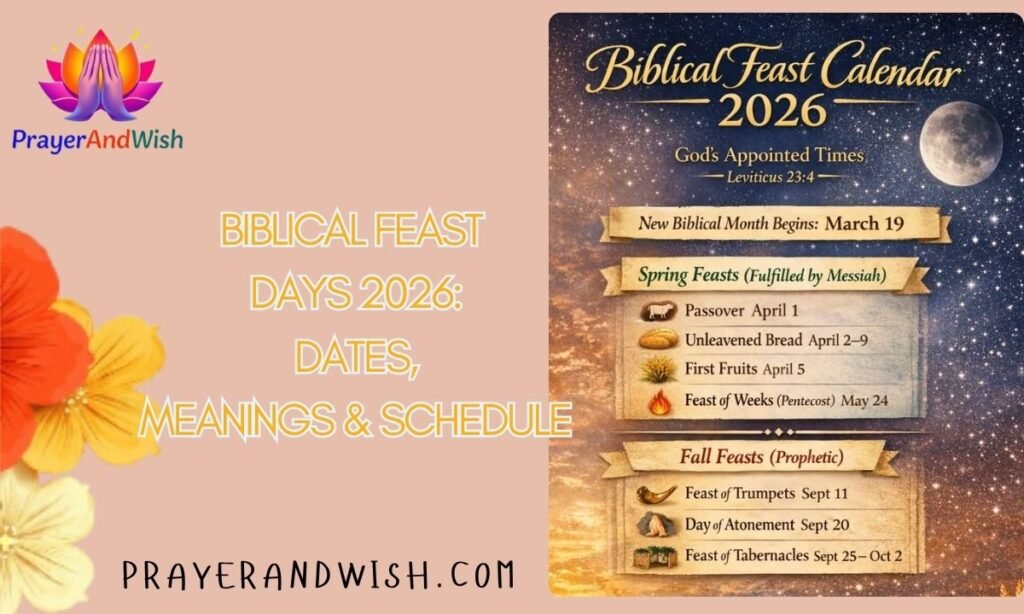
Here are all seven feasts with their 2026 dates. Keep in mind that on the Hebrew calendar, each day begins at sundown the evening before.
| Feast | Hebrew Name | 2026 Date |
| Passover | Pesach | April 1 (begins evening March 31) |
| Feast of Unleavened Bread | Chag HaMatzot | April 2–8 |
| Feast of First Fruits / Pentecost | Shavuot | May 22–24 |
| Feast of Trumpets | Yom Teruah | September 11–13 |
| Day of Atonement | Yom Kippur | September 20–21 |
| Feast of Tabernacles | Sukkot | September 26–October 2 |
| Eighth Day | Shemini Atzeret | October 2–3 |
Note: Minor date variations exist across traditions (rabbinic, Messianic, Karaite). The dates above reflect consensus from leading biblical calendar sources.
Passover and the Feast of Unleavened Bread
Passover falls on April 1, 2026, beginning at sundown on March 31. It is the oldest of the seven feasts and the foundation of the entire calendar.
It commemorates the night God spared Israel in Egypt. The blood of a lamb on the doorpost protected every household. The New Testament identifies Jesus as the ultimate fulfillment of that lamb (1 Corinthians 5:7).
What Passover Means Spiritually
Passover is not just a history lesson. It is a declaration that without shed blood, there is no forgiveness. Every element of the Passover meal points forward to the cross.
The lamb had to be spotless. It was slain at twilight. Its blood was applied by faith. Jesus fulfilled each one of these details precisely, making Passover one of the most prophetically loaded events in all of Scripture.
The Feast of Unleavened Bread
This feast runs from April 2–8, 2026. During these seven days, no leavened bread is eaten. Leaven in Scripture consistently represents sin and corruption.
Removing it from your home is more than symbolic. It is an active picture of putting sin out of your life. The holy convocations on the first and last days of this feast are commanded rest days. No ordinary work is done on either day (Leviticus 23:7–8).
Feast of First Fruits and Pentecost (Shavuot)
First Fruits begins the counting of fifty days toward Pentecost. In 2026, Pentecost (Shavuot) lands on May 22–24, depending on which tradition you follow.
This feast celebrates the early harvest. Paul writes in 1 Corinthians 15:20 that Jesus rose from the dead as the “firstfruits” of all who have died, directly connecting His resurrection to this feast.
The Significance of Pentecost
Fifty days after First Fruits, Pentecost marks the outpouring of the Holy Spirit described in Acts 2. The disciples were gathered in Jerusalem when wind filled the room and tongues of fire appeared.
This was not random timing. It happened on Shavuot intentionally. God used His own appointed calendar to announce the birth of the Church.
Counting the Omer
Between First Fruits and Pentecost, Scripture commands a daily count of fifty days called the Omer. This period is one of anticipation and preparation.
Many believers use this time for intentional prayer, Scripture reading, and self-examination. The counting begins on April 5, 2026, and concludes on Pentecost in late May.
The Fall Feasts of 2026
The three major fall feasts arrive in September and October. These feasts are tied to prophetic events that have not yet happened.
They describe a sequence: a trumpet call announcing judgment, a day of full atonement, and then a joyful kingdom celebration. Many scholars see them as a roadmap for the end times.
Feast of Trumpets: September 11–13, 2026
The Feast of Trumpets is marked by the blowing of the shofar, a ram’s horn. It begins the holiest season on the Hebrew calendar.
In 1 Thessalonians 4:16, Paul writes that Christ will return with the sound of a trumpet. This feast is widely understood to foreshadow that moment. It is a day of solemn assembly and, for many, a call to repentance before the Day of Atonement.
Day of Atonement: September 20–21, 2026
Yom Kippur is the most solemn day on the entire biblical calendar. It is observed with a 24-hour fast and a complete cessation of work.
In ancient Israel, the high priest entered the Holy of Holies just once per year, on this day, to make atonement for the nation’s sins. Hebrews 9–10 describes how Jesus fulfilled this role completely and permanently. Leviticus 16 contains the full priestly ritual.
Feast of Tabernacles: September 26–October 2, 2026
Sukkot is seven days of celebration. Families build temporary shelters called sukkot and eat and dwell in them to remember Israel’s forty years in the wilderness.
This feast also looks forward. Zechariah 14:16 says that in the age to come, all nations will go up to Jerusalem to celebrate the Feast of Tabernacles. It pictures the millennial reign of Christ when He rules over the earth from Jerusalem.
The Eighth Day: Shemini Atzeret (October 2–3, 2026)
Shemini Atzeret is often overlooked but carries deep meaning. It comes immediately after Tabernacles and stands alone as its own convocation.
This day pictures what comes after the millennium. It points to the final resurrection described in Revelation 20:11–13 and the eternal state where God dwells forever with His people.
Why the Eighth Day Matters
The number eight in Scripture often signals new beginnings. After seven days of Tabernacles, the Eighth Day opens something entirely new.
It is the solemn close of the annual feast cycle. It pictures a future beyond the millennial kingdom, a permanent state of life with God that never ends. Numbers 29:35 commands it as a holy convocation with offerings and complete rest from work.
How Days Begin in the Biblical Calendar
Every biblical feast begins at sundown, not midnight. This follows the creation pattern in Genesis 1 where evening is listed before morning.
This means, for example, that Passover 2026 begins at sundown on March 31 and concludes at sundown on April 1. When planning to observe these feasts, always check which evening a feast actually starts on.
Why Dates Can Vary Slightly
Different communities follow slightly different calendar methods. Rabbinic Judaism follows the fixed Hillel II calendar established around 359 CE. Karaite Jews rely on actual sighting of the new moon crescent.
Other Messianic and Hebrew roots groups use variations based on astronomical new moons or ancient Dead Sea Scroll calendars.
The core dates in this article are based on the widely used rabbinic calendar, which most Messianic congregations and organizations like the United Church of God follow. Minor date shifts of one to two days are common across traditions.
Frequently Asked Questions
What are the seven biblical feast days?
Passover, Feast of Unleavened Bread, Feast of First Fruits/Pentecost, Feast of Trumpets, Day of Atonement, Feast of Tabernacles, and the Eighth Day.
Are the biblical feasts still relevant for Christians today?
Many Christians and Messianic believers observe them as prophetically significant appointed times pointing to Christ.
When does Passover 2026 begin?
Passover begins at sundown on March 31, 2026.
What is the most solemn of the biblical feasts?
The Day of Atonement (Yom Kippur) is considered the most solemn, observed with fasting and no work.
Why do feast dates change each year on the Gregorian calendar?
The Hebrew calendar is lunisolar and tied to moon cycles, so feast dates shift on the Gregorian calendar every year.
What does the shofar have to do with the biblical feasts?
The shofar is blown at the Feast of Trumpets to signal the start of the fall holy season and is connected prophetically to Christ’s return.
Are the biblical feasts the same as Jewish holidays?
They overlap significantly, but God calls them His own appointed times in Leviticus 23:2, not solely Jewish observances.
Conclusion
The biblical feast days in 2026 run from Passover in April through the Eighth Day in October. Each feast tells part of a larger story, from Israel’s redemption out of Egypt to a coming kingdom that never ends. Whether you observe them liturgically or study them prophetically, these seven appointments remain as relevant today as when God first instituted them in the wilderness.

Hayat has 10 years of experience creating content on Bible verses, prayers, and blessings. She runs PrayerAndWish.com, sharing simple and meaningful spiritual guidance.