
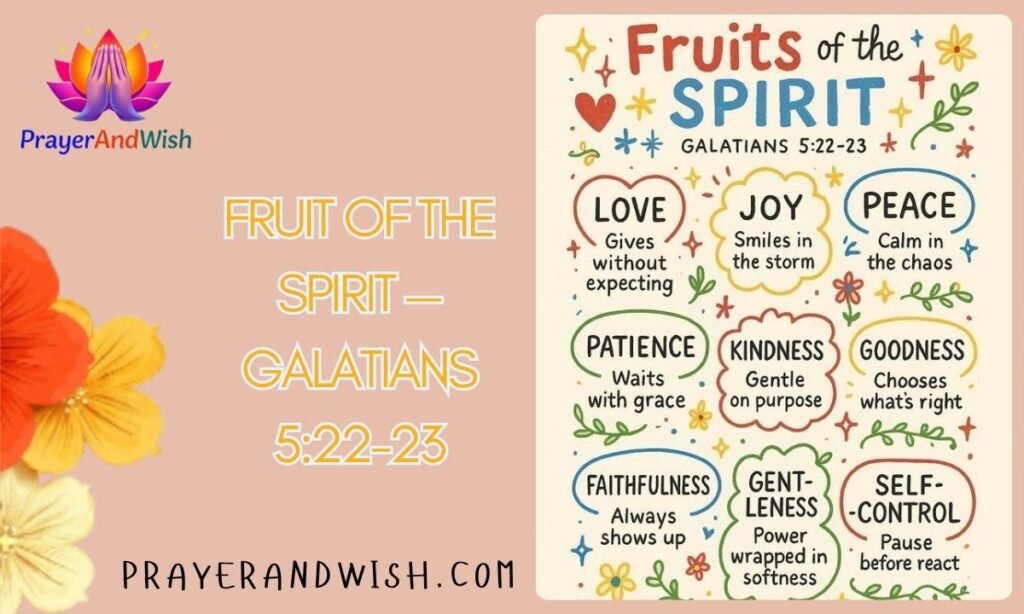
Most people can name a few of them — but very few understand what they actually mean. These nine qualities aren’t rules to follow or boxes to check. They reveal something much deeper about who God is and who He’s shaping you to become.
What Is the Fruit of the Spirit in Galatians?
Galatians 5:22-23 lists nine qualities that grow naturally in a believer’s life through the Holy Spirit. Paul contrasts them directly with the works of the flesh in the verses just before — making it clear that these qualities come from surrender to the Spirit, not human effort.
The Full List — All Nine in One Place
1. Love
Agape love in action: This is not romantic love or friendship — it is unconditional, self-giving love that mirrors God’s own character. 1 John 4:8 says God is love, so this fruit is the foundation of everything that follows.
Why it comes first: Every other fruit flows out of love. Romans 5:5 confirms that God has poured this love into believers’ hearts through the Holy Spirit. You don’t manufacture it — you receive it and let it overflow into others.
2. Joy
Joy versus happiness: Happiness depends on circumstances. Biblical joy does not. Nehemiah 8:10 calls the joy of the Lord your strength — it holds steady even in suffering, grief, or uncertainty.
Where it comes from: Joy is rooted in your relationship with God, not your situation. John 15:11 shows Jesus saying He shares His joy so that yours may be complete. This is not something you chase — it grows as you abide in Him.
3. Peace
Peace that defies logic: Philippians 4:7 describes God’s peace as something that “surpasses all understanding.” It guards your heart and mind even when your external situation gives you every reason to worry.
How peace grows: Isaiah 26:3 links perfect peace to a mind fixed on God. The more you trust Him with your circumstances, the more this fruit becomes visible in how you respond to pressure, conflict, and the unknown.
4. Patience
Long-suffering, not just waiting: The Greek word here is makrothumia — it means bearing with people and situations over a long stretch without losing heart. It is active endurance, not passive tolerance.
Where it gets tested: Romans 5:3-4 says suffering produces patience. God doesn’t just give you patience as a gift in a quiet moment — He develops it through real situations that require you to wait on Him and extend grace to others.
5. Kindness
Kindness as a witness: Kindness in scripture isn’t soft sentiment — it is practical, deliberate goodness toward others. Ephesians 4:32 says to be kind and compassionate, forgiving each other just as God forgave you.
The Spirit’s role: You cannot sustain genuine kindness toward difficult people on willpower alone. The Holy Spirit produces a kindness that stays consistent even when it isn’t returned — because its source is God’s character, not your mood.
6. Goodness
Goodness in deeds: Where kindness is the disposition, goodness shows up in action. Galatians 6:10 calls believers to do good to everyone, especially fellow believers. It is integrity lived out in ordinary moments.
Rooted in God’s nature: Psalm 34:8 says “taste and see that the Lord is good.” As believers reflect His character, goodness becomes visible in honesty, generosity, and right living — not as performance, but as overflow.
7. Faithfulness
Reliability over time: Faithfulness means showing up consistently — to God, to your word, and to the people in your life. Proverbs 3:3 says to let love and faithfulness never leave you, binding them around your neck and writing them on your heart.
The fruit of trust: Matthew 25:21 records the master’s praise — “well done, good and faithful servant.” Faithfulness isn’t dramatic. It is doing the right thing in small, unseen moments over a long period of time.
8. Gentleness
Strength under control: The Greek word prautēs is often translated meekness — but it does not mean weakness. It describes power that is submitted and controlled. Jesus used this word to describe Himself in Matthew 11:29.
Why it matters in relationships: Gentleness disarms conflict and earns trust. Proverbs 15:1 says a gentle answer turns away wrath. A person growing in this fruit responds to provocation with measured grace rather than reaction.
9. Self-Control
The closing fruit: Paul ends with self-control — the fruit that holds all the others together. It is the Spirit-enabled ability to say no to destructive impulses and yes to what aligns with God’s purposes for your life.
Freedom, not restriction: Galatians 5:1 opens the whole passage with a call to freedom. Self-control is not a cage — it is the discipline that protects freedom. Without it, every other fruit can be undermined by unchecked behavior or unchecked words.
All Nine Fruits — Quick Reference
| Fruit | Greek Word | Core Meaning | Key Scripture |
| Love | Agape | Unconditional, self-giving | Romans 5:5 |
| Joy | Chara | Delight rooted in God | John 15:11 |
| Peace | Eirene | Inner calm beyond circumstances | Philippians 4:7 |
| Patience | Makrothumia | Long-suffering endurance | Romans 5:3-4 |
| Kindness | Chrestotes | Practical goodness toward others | Ephesians 4:32 |
| Goodness | Agathosune | Integrity in action | Galatians 6:10 |
| Faithfulness | Pistis | Reliable and consistent | Matthew 25:21 |
| Gentleness | Prautēs | Controlled, submitted strength | Matthew 11:29 |
| Self-Control | Enkrateia | Discipline that protects freedom | Galatians 5:1 |
Frequently Asked Questions
Where exactly is the fruit of the Spirit in the Bible?
Galatians 5:22-23, written by the apostle Paul.
Why is it called “fruit” and not “fruits”?
The singular “fruit” suggests one unified character produced by the Spirit, not nine separate achievements.
Can a non-Christian have these qualities?
People can show similar traits, but the fruit of the Spirit specifically grows through the Holy Spirit’s work in a believer.
How do you grow the fruit of the Spirit?
By staying connected to God through prayer, scripture, and obedience — John 15:5 calls this “abiding.”
How do you grow the fruit of the Spirit?
By staying connected to God through prayer, scripture, and obedience — John 15:5 calls this “abiding.”
What comes before the fruit of the Spirit in Galatians 5?
The works of the flesh (verses 19-21), which Paul contrasts directly with the Spirit’s fruit.
Is self-control the most important fruit?
No single fruit outranks the others — they work together as one expression of Christ-like character.
How long does it take to develop the fruit of the Spirit?
It’s a lifelong process — fruit grows gradually through consistent faith and daily surrender to the Holy Spirit.
Conclusion
The fruit of the Spirit in Galatians 5:22-23 is not a checklist — it is a portrait of a life shaped by the Holy Spirit over time. Each quality builds on the last, and together they reflect the character of Jesus Himself. You don’t grow this fruit by trying harder — you grow it by staying close to the One who produces it in you.

Hayat has 10 years of experience creating content on Bible verses, prayers, and blessings. She runs PrayerAndWish.com, sharing simple and meaningful spiritual guidance.