You read the list. It feels direct. Almost uncomfortable. Seven simple statements, yet they expose the human heart. What if these aren’t just ancient warnings but a mirror for today?
Understanding Proverbs 6:16–19 in Context
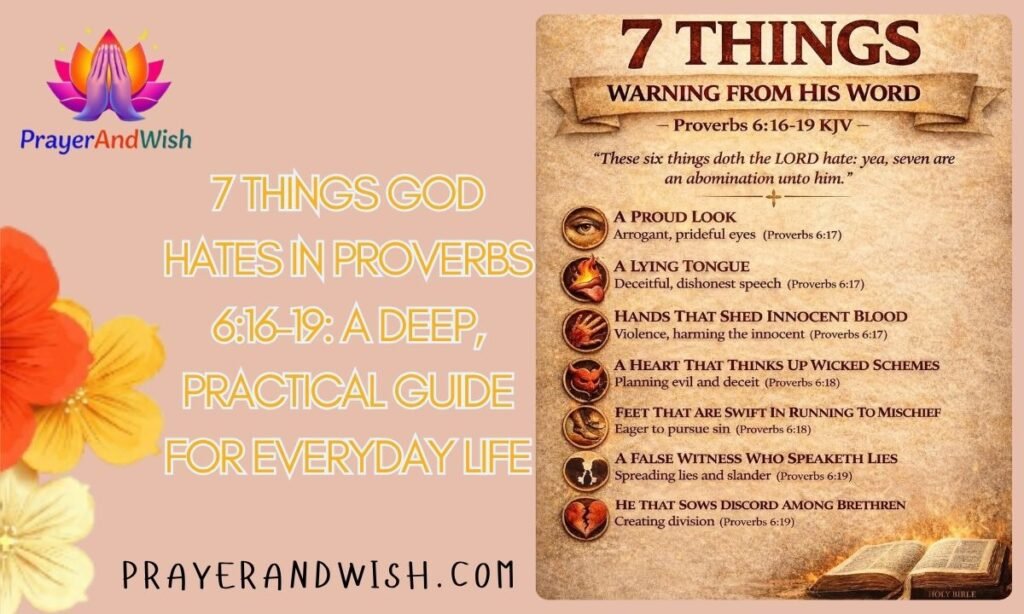
The passage in Proverbs 6:16–19 presents a structured list: “six things the Lord hates, seven that are detestable.” This literary style emphasizes completeness and intensity. It is not suggesting that God hates only seven things. Instead, it highlights core attitudes and behaviors that damage both individuals and communities.
At its core, this passage is about relational ethics. Every item on the list disrupts trust, destroys unity, or harms others. These are not abstract sins. They are practical, visible, and deeply rooted in everyday life.
Wisdom literature, especially Proverbs, focuses on lived behavior. It teaches that wisdom is not just knowledge but applied character. In this sense, avoiding these seven things is not only about obedience to God but also about building a stable, healthy life.
Why These Seven Things Matter Today
Modern culture often normalizes behaviors like exaggeration, subtle dishonesty, pride, or gossip. Proverbs challenges that normalization. It draws a clear line between what is acceptable in society and what aligns with God’s character.
Each of these seven behaviors breaks trust. And trust is the foundation of every relationship, whether in family, business, friendships, or faith communities.
If you examine them closely, you will notice a pattern:
- They begin internally (attitude and heart)
- They move outward (words and actions)
- They end socially (impact on community)
This progression shows that sin is not random. It starts within and eventually affects others.
1. Haughty Eyes (Pride)
What It Means
“Haughty eyes” refer to arrogance. It is the attitude of superiority, where a person looks down on others. This is not just confidence. It is inflated self-importance.
Pride says:
- “I am better than you.”
- “I deserve more than you.”
- “I don’t need correction.”
Why God Hates It
Pride distorts reality. It removes humility, which is essential for growth and relationships. A proud person cannot learn, cannot listen, and often cannot love properly.
Pride also isolates. It creates invisible walls between people. Others feel judged, dismissed, or undervalued.
Real-Life Impact
In daily life, pride shows up in subtle ways:
- Interrupting others constantly
- Refusing to admit mistakes
- Taking credit without acknowledgment
- Looking down on people with less success or status
Over time, pride damages trust. People withdraw from those who consistently elevate themselves.
Practical Response
- Practice listening without interrupting
- Acknowledge others’ contributions openly
- Admit when you are wrong
- Serve someone without expecting recognition
Humility builds connection. Pride destroys it.
2. A Lying Tongue
What It Means
A lying tongue refers to intentional dishonesty. This includes:
- Direct lies
- Half-truths
- Exaggeration
- Misleading statements
It is not limited to major deception. Even small distortions fall into this category.
Why God Hates It
Truth is foundational to trust. Once truth is compromised, relationships weaken. Lies create confusion, suspicion, and distance.
Dishonesty also reflects internal disorder. Words reveal what is in the heart. A pattern of lying often points to deeper issues like insecurity, fear, or selfish ambition.
Real-Life Impact
Lying appears in everyday situations:
- Inflating achievements
- Hiding mistakes
- Spreading unverified information
- Manipulating facts to gain advantage
Even “small lies” accumulate. Over time, credibility erodes.
Practical Response
- Speak accurately, even when it costs you
- Avoid exaggeration for effect
- Verify information before sharing
- Choose silence instead of dishonest speech
Truth builds long-term respect, even when it is uncomfortable.
3. Hands That Shed Innocent Blood
What It Means
This refers to acts of violence against the innocent. While it includes extreme cases like murder, it also extends to harm inflicted on vulnerable people. The principle here is misuse of power.
Why God Hates It
Human life holds inherent value. Harming the innocent violates that value. It represents injustice at its most severe level.
This behavior reflects a complete disregard for others. It prioritizes personal gain or anger over human dignity.
Real-Life Impact
While most people do not commit physical violence, the broader application includes:
- Supporting systems that exploit others
- Ignoring injustice when you have influence
- Using authority to harm rather than protect
It is about how you treat those who cannot defend themselves.
Practical Response
- Advocate for fairness where possible
- Speak up against injustice
- Use influence to protect, not exploit
- Support those in vulnerable positions
Justice is not passive. It requires intentional action.
4. A Heart That Devises Wicked Schemes
What It Means
This points to intentional planning of wrongdoing. It is not accidental sin. It is calculated.
The “heart” represents the inner control center:
- Thoughts
- Intentions
- Desires
Why God Hates It
This behavior shows premeditated harm. It is not a moment of weakness. It is deliberate and also reveals that sin begins internally. Actions are simply the outcome of prior thought patterns.
Real-Life Impact
Examples include:
- Planning to deceive someone
- Strategizing ways to manipulate outcomes
- Intentionally undermining others
- Plotting revenge
This mindset damages both the planner and the target.
Practical Response
- Examine your intentions regularly
- Replace harmful thoughts with constructive ones
- Avoid environments that encourage negative planning
- Seek accountability when struggling with harmful patterns
Transformation starts at the thought level.
5. Feet That Are Quick to Rush into Evil
What It Means
This describes eagerness to do wrong. It is not just participation in evil but enthusiasm for it.
The emphasis is on speed and willingness.
Why God Hates It
This reflects a heart that prefers wrongdoing. There is no hesitation, no internal resistance.
It indicates moral desensitization. Over time, repeated exposure to wrongdoing reduces sensitivity to it.
Real-Life Impact
You see this when people:
- Quickly join gossip or drama
- Rush into harmful decisions without reflection
- Seek out opportunities for wrongdoing
- Encourage others to participate in harmful behavior
This creates a culture where negativity spreads quickly.
Practical Response
- Pause before acting in emotionally charged situations
- Build habits of reflection and restraint
- Surround yourself with people who value integrity
- Train yourself to choose good consistently
Speed matters. Slow down before acting.
6. A False Witness Who Pours Out Lies
What It Means
This is a more specific form of lying. It involves giving false testimony that harms another person.
It includes:
- Slander
- Defamation
- False accusations
Why God Hates It
This behavior directly damages reputations. It can destroy lives, relationships, and opportunities.
Unlike general lying, this type targets individuals intentionally.
Real-Life Impact
Today, this often appears as:
- Spreading rumors
- Posting false claims online
- Misrepresenting someone’s actions
- Sharing private information inaccurately
In a digital world, the damage multiplies quickly.
Practical Response
- Do not share unverified information
- Defend others when falsely accused
- Clarify facts before forming conclusions
- Take responsibility if you spread something incorrect
Words have power. Use them carefully.
7. One Who Sows Discord Among Brothers
What It Means
This refers to creating division within relationships or communities.
It is not about disagreement. It is about intentional disruption.
Why God Hates It
Unity is essential for healthy communities. Division weakens groups and creates instability.
This behavior often stems from selfish motives:
- Desire for control
- Need for attention
- Personal insecurity
Real-Life Impact
You see this in:
- Gossip that creates mistrust
- Taking sides to fuel conflict
- Misrepresenting conversations
- Encouraging division in families or teams
This is often the most destructive behavior on the list because it affects multiple people at once.
Practical Response
- Promote clarity and honest communication
- Avoid spreading partial or biased information
- Address conflicts directly, not indirectly
- Encourage reconciliation where possible
Unity requires effort. Division happens easily.
A Deeper Pattern: From Heart to Community
These seven behaviors follow a clear progression:
- Attitude (pride)
- Speech (lying)
- Action (violence)
- Intention (planning evil)
- Momentum (eagerness)
- Targeted harm (false witness)
- Social impact (division)
This pattern shows that personal character always affects others. No action exists in isolation.
How to Apply This in Daily Life
1. Self-Examination
Start by asking:
- Do I struggle with pride?
- Am I fully honest in my speech?
- Do my actions reflect integrity?
Awareness is the first step toward change.
2. Build Opposite Habits
Replace each negative behavior with a positive one:
- Pride → Humility
- Lying → Truthfulness
- Harm → Compassion
- Evil planning → Integrity
- Rash action → Thoughtfulness
- False witness → Fairness
- Division → Peacemaking
3. Strengthen Relationships
Focus on:
- Honest communication
- Respectful disagreement
- Consistent reliability
These build trust over time.
4. Control Input
What you consume shapes your thinking:
- Media
- Conversations
- Social influences
Choose inputs that reinforce wisdom, not chaos.
Final Reflection
Proverbs 6:16–19 is not just a warning. It is a diagnostic tool. It reveals what damages life at its core. Each item challenges you to examine not just what you do, but why you do it.
The goal is not perfection. The goal is alignment. When your attitudes, words, and actions align with truth and humility, relationships improve naturally.
And that is the deeper purpose of this passage. It is not just about avoiding what God hates. It is about becoming someone who reflects what God values.

Hayat has 10 years of experience creating content on Bible verses, prayers, and blessings. She runs PrayerAndWish.com, sharing simple and meaningful spiritual guidance.