You sleep eight hours and still wake up exhausted. You take weekends off but return to Monday feeling drained. Something is missing — and the Bible understood it long before modern science caught up.
Rest Is More Than Sleep
God designed rest as a complete system, not just a nightly routine.
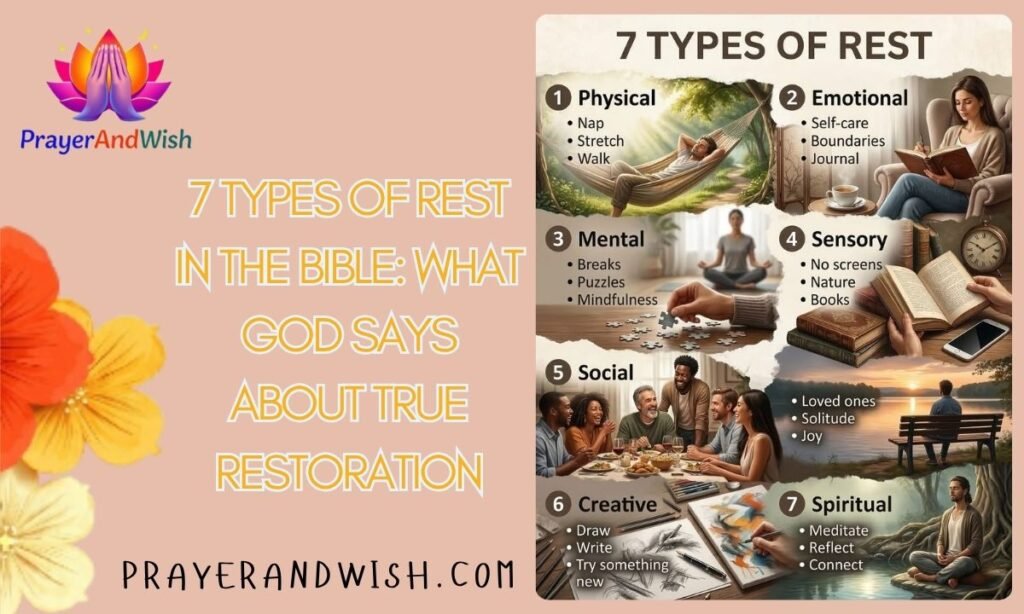
When God rested on the seventh day, he wasn’t tired. He modeled something intentional — a rhythm of restoration built into creation itself. Dr. Saundra Dalton-Smith, author of Sacred Rest, identified seven distinct types of rest that align directly with this biblical design. Sleep is just one piece of a much larger picture.
The 7 Types of Rest — With Biblical Roots
Each type addresses a different kind of exhaustion.
Scripture doesn’t just tell us to rest. It shows us how — through the life of Jesus, the Psalms, and direct commands that cover body, mind, and soul. Here is every type explained clearly.
1. Physical Rest
Passive and active recovery — Physical rest includes sleep, naps, stretching, walking, and massage. Jesus himself sat down at Jacob’s well because he was weary from travel (John 4:6). Even the Son of God honored his body’s need to stop.
What the Bible says: “Come to me, all you who are weary and burdened, and I will give you rest” (Matthew 11:28). God doesn’t shame physical weakness. He meets it. Push your body, yes — but schedule recovery with the same seriousness you schedule work.
2. Mental Rest
Quieting the noise inside your head — Mental rest means giving your brain a break from constant decision-making, rumination, and mental to-do lists. Psalm 46:10 says plainly, “Be still and know that I am God.” That stillness is not passive laziness. It is active trust.
Practical application: The person who can’t turn their brain off at night has a mental rest deficit. Scripture encourages journaling your burdens rather than carrying them silently. Offload your thoughts — onto paper, or in prayer. Philippians 4:6 tells us to present our anxieties to God rather than rehearse them endlessly.
3. Emotional Rest
Releasing what you’ve been holding together — Emotional rest means being honest about how you feel instead of performing strength you don’t have. 1 Peter 5:7 says to cast all your anxiety on God “because he cares for you.” That’s an invitation to stop pretending.
The cost of skipping this: Emotional labor is exhausting. Saying “I’m fine” when you’re not drains energy silently. An emotionally rested person can answer truthfully — with God, in prayer, with a trusted friend, or in a journal. Real restoration starts with real honesty.
4. Social Rest
Choosing life-giving relationships over draining ones — Social rest isn’t just introvert behavior. Jesus regularly withdrew from crowds — even well-meaning ones — to be alone or with a small circle (Mark 6:31). He understood that constant social output without replenishment leads to depletion.
What this looks like today: Look at your relationships and ask honestly who pours into you and who consistently pulls from you. That’s not unkind — it’s wisdom. Surround yourself more intentionally with people who restore your energy rather than consume it.
5. Sensory Rest
Reducing the constant noise of modern life — Your brain filters every sound, screen, and notification — even the ones you think you’re ignoring. That filtering takes real energy. Psalm 4:8 says “In peace I will lie down and sleep.” Peace, by definition, is the absence of sensory chaos.
Simple steps that work: Close your eyes for five minutes mid-afternoon. Step outside without your phone. Sit in a dim, quiet room. These aren’t luxuries. They’re brain resets — the same principle as rebooting a frozen computer. Five minutes of stillness can undo hours of sensory overload.
6. Creative Rest
Letting beauty refill what problem-solving drains — If your job demands creativity, brainstorming, or innovation, you need creative rest. Ephesians 2:10 calls us “God’s handiwork” — we are made by a Creator, in his image, to be creative. But creativity needs fuel.
How to get it: Creative rest is not about producing art. It’s about receiving it. Visit a park. Watch a sunset. Walk through a museum. Listen to music that moves you. These experiences awaken wonder and restock the creative reserves that daily work depletes. Nature works especially well — it’s been doing this since Genesis 1.
7. Spiritual Rest
Connecting to purpose beyond your daily grind — Spiritual rest is the deepest kind. It addresses the soul-level question: does my life mean anything? Matthew 11:28 is the foundation. Jesus offers rest not just for tired bodies but for worn-out souls.
Beyond religion: Spiritual rest includes prayer, worship, and faith practice — but also volunteering, community service, or any act of giving that connects you to something bigger than yourself. When you feel numb, purposeless, or quietly hopeless, your spirit is asking for restoration. Feed it intentionally.
Quick Reference Table
| Type | Biblical anchor | Core need it meets |
| Physical | John 4:6 | Body recovery |
| Mental | Psalm 46:10 | Thought quieting |
| Emotional | 1 Peter 5:7 | Honest expression |
| Social | Mark 6:31 | Relational balance |
| Sensory | Psalm 4:8 | Stimulus reduction |
| Creative | Ephesians 2:10 | Wonder and inspiration |
| Spiritual | Matthew 11:28 | Meaning and belonging |
Frequently Asked Questions
What are the 7 types of rest in the Bible?
Physical, mental, emotional, social, sensory, creative, and spiritual rest — each backed by Scripture.
Did Jesus practice all 7 types of rest?
Yes — he slept, withdrew from crowds, prayed alone, and regularly sought solitude and nature.
Is the Sabbath only about physical rest?
No. The Sabbath covered body, spirit, and community — a holistic reset, not just a day off work.
What type of rest does prayer provide?
Primarily spiritual and emotional rest — it releases burdens and reconnects you to purpose.
Can rest be active, not just sleep?
Yes. Walking, stretching, worship, and nature all count as genuine rest depending on the type.
How do I know which type of rest I need most?
Look at the last 24 hours — where did you spend the most energy? Start restoring there first.
Conclusion
The 7 types of rest in the Bible are not a self-help trend — they are a God-designed framework for human flourishing. Sleep matters, but it cannot do the work of all seven. When you learn to rest the way Scripture models, you stop running on empty and start living from a place of genuine restoration. The Great I AM invites you to rest — all of you, not just the tired parts.

Hayat has 10 years of experience creating content on Bible verses, prayers, and blessings. She runs PrayerAndWish.com, sharing simple and meaningful spiritual guidance.