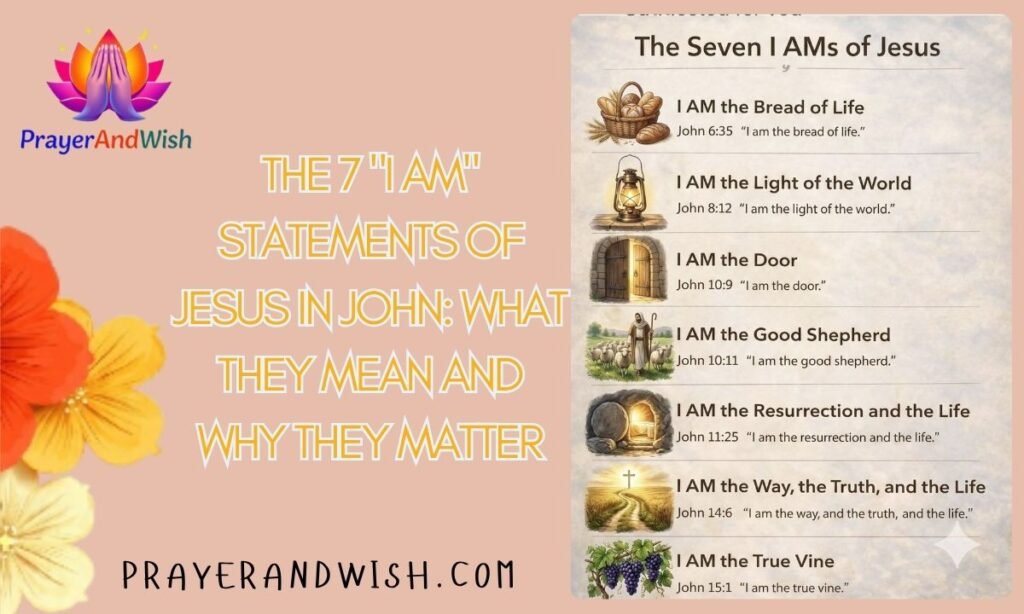
Jesus said things no one else had ever said. He didn’t just teach about God — he claimed to be the answer to humanity’s deepest needs. Seven times in the Gospel of John, he made bold declarations starting with “I am.” Each one pointed to a different aspect of who he is. Together, they form a complete picture of the Son of God.
Why the “I Am” Statements Matter
They are rooted in the name of God himself.
In Exodus 3:14, when Moses asked God his name, God replied: “I AM WHO I AM.” That phrase — “I AM” — became the sacred name of God in Jewish tradition. So when Jesus used the same words, everyone listening understood exactly what he was claiming. He wasn’t being poetic. He was identifying himself as God in the flesh.
Each statement came with proof.
Jesus didn’t just make claims — he backed them up. He said he was the bread of life right after feeding five thousand people. He said he was the resurrection and the life right before raising Lazarus from the dead. His words and actions worked together. That pattern runs through all seven declarations.
The 7 “I Am” Statements Explained
1. “I Am the Bread of Life” — John 6:35
What he said: “I am the bread of life; whoever comes to me shall not hunger, and whoever believes in me shall never thirst.”
The Israelites received manna in the wilderness — bread from heaven. But they still died. Jesus drew a direct contrast: the manna sustained physical life temporarily, while he offers eternal life to all who come to him. This statement came right after he miraculously fed a crowd of over five thousand people with just five loaves and two fish. The miracle pointed to a deeper truth. Physical food fills you for a few hours. Jesus satisfies permanently.
If you feel spiritually empty despite religious activity, this statement speaks directly to that. The bread of life isn’t found in church programs or busy schedules. It is found in Christ himself.
2. “I Am the Light of the World” — John 8:12
What he said: “Whoever follows me will not walk in darkness, but will have the light of life.”
This declaration came just before Jesus opened the eyes of a man who had been born blind. The physical healing illustrated the spiritual reality. Jesus doesn’t just light up the path ahead — he gives you the ability to see it.
Darkness in this context refers to spiritual blindness, confusion, and separation from God. Light is truth, clarity, and the knowledge of God. In a world that grows more spiritually confusing every day, this statement remains as relevant as ever. Following Jesus means you are no longer stumbling in the dark.
3. “I Am the Door of the Sheep” — John 10:7, 9
What he said: “If anyone enters by me, he will be saved.”
Jesus used the imagery of a sheepfold — a stone enclosure where shepherds kept their flocks safe at night. The shepherd would literally lie across the entrance, becoming the door. No sheep went in or out without passing through him.
The exclusivity here is intentional. Jesus was not saying he is a door. He said he is the door. Every other claimed path to God — every philosophy, every religion, every self-improvement system — bypasses the only entrance that leads to safety and salvation. This is not a harsh statement. It is a rescue announcement.
4. “I Am the Good Shepherd” — John 10:11, 14
What he said: “The good shepherd lays down his life for the sheep.”
In the Old Testament, God described himself as a shepherd caring for Israel. When Jesus used the same title, he was making a direct claim to that divine role. But he went further. A hired hand runs when the wolf shows up. The good shepherd stays — even at the cost of his life.
The religious leaders of Jesus’ day were supposed to be shepherds of God’s people. Instead, they used their position for personal gain and abandoned the flock when it cost them something. Jesus stood in sharp contrast. He was the shepherd who did not run. He fulfilled this statement completely on the cross.
5. “I Am the Resurrection and the Life” — John 11:25
What he said: “Whoever believes in me, though he die, yet shall he live.”
He said this to Martha, whose brother Lazarus had been in a tomb for four days. Then he walked to that tomb and called a dead man back to life. The miracle wasn’t just a compassionate act — it was a demonstration. Jesus holds authority over death itself.
This matters beyond the grave. For anyone carrying grief, despair, or a sense that something in their life is beyond repair, this statement carries enormous weight. If Jesus can raise the physically dead, he can certainly restore what feels lost, broken, or hopeless. No situation is too far gone.
6. “I Am the Way, the Truth, and the Life” — John 14:6
What he said: “No one comes to the Father except through me.”
This is perhaps the most contested statement Jesus ever made. The world today pushes back against it just as fiercely as it did two thousand years ago. But Jesus was not offering an opinion. He was stating a fact — one backed by his resurrection.
Three claims packed into one: He is the way — the only path to God. He is the truth — not merely truthful, but truth itself. He is the life — the source and sustainer of all life, physical and eternal. You cannot separate these three. They stand or fall together. And for the Christian, they stand.
7. “I Am the True Vine” — John 15:1, 5
What he said: “Apart from me you can do nothing.”
Cut a branch off a vine and toss it on the ground. It cannot produce a single grape, no matter how much effort it puts in. The life of the vine is the only thing that makes fruit possible. Jesus used this image to make a simple but staggering point: spiritual fruitfulness does not come from trying harder. It comes from staying connected to him.
This is freeing, not frustrating. You are not the vine. He is. Your job is to abide — to remain in relationship with him. When you do, fruit is a natural result, not a forced performance. When you drift, you wither. The solution is always the same: come back to the vine.
Frequently Asked Questions
What does “I AM” mean in the Bible?
“I AM” is the name God revealed to Moses in Exodus 3:14 — it signals eternal, self-existent deity.
How many “I am” statements did Jesus make in John?
Seven metaphorical statements, plus two direct “I AM” declarations (John 8:58 and 18:5-6).
Why did soldiers fall to the ground in John 18:6?
When Jesus said “I am” in the garden, his divine power caused the armed crowd to fall backward involuntarily.
Are the 7 “I am” statements only in John?
Yes — all seven metaphorical declarations appear exclusively in the Gospel of John.
What is the most important “I am” statement?
All seven are equally significant, though John 14:6 is most frequently cited for its direct claim about salvation.
Did Jesus claim to be God with these statements?
Yes — by using the language of Exodus 3:14, he made a clear claim to divine identity that his listeners understood immediately.
Conclusion
The seven “I am” statements of Jesus in the Gospel of John are not just poetic declarations — they are the clearest picture we have of who Jesus claimed to be. He is bread, light, door, shepherd, resurrection, way, and vine. Each statement answers a real human need. And each one stands on the evidence of what he actually did. Understanding these seven statements changes how you read the Gospels, how you pray, and how you live.

Hayat has 10 years of experience creating content on Bible verses, prayers, and blessings. She runs PrayerAndWish.com, sharing simple and meaningful spiritual guidance.