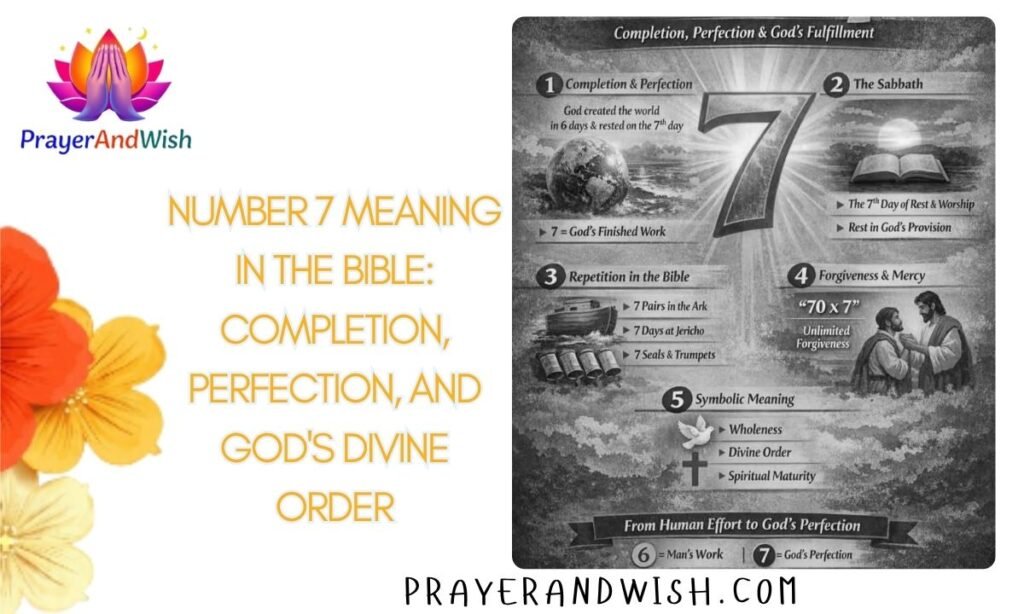
It shows up in creation, in Israel’s laws, in the words of Jesus, and across every page of Revelation. The number 7 is everywhere in the Bible — but most people never stop to ask why. Once you see what it actually signals, you will never read Scripture the same way again.
What Does the Number 7 Mean in the Bible?
The number 7 is the most consistently symbolic number in all of Scripture. From Genesis to Revelation, it signals completion, divine perfection, and the full expression of God’s purposes — not as coincidence, but as intentional design woven into the text.
Rooted in the Hebrew Language Itself
Seven and fullness share the same root. In Hebrew, the word for “seven” (sheva) shares its consonants with the word for “full” or “complete” (savea). Biblical writers were not just counting when they used 7. They were signaling that something had reached its God-intended wholeness. This linguistic connection explains why the number appears so persistently across every genre of Scripture.
Not every 7 is symbolic. It is worth saying clearly: not every appearance of the number carries theological weight. Some sevens in the Bible are simply counts. But when scholars isolate the deliberate patterns — seven key words in Genesis 1:1, seven paragraphs in the creation account, seven “I AM” statements in John — the intentionality becomes impossible to dismiss. The number was chosen carefully, consistently, and with purpose.
Seven in the Creation Account
Genesis 1 is where the symbolism begins. The very structure of the opening chapter is built around 7, and that structure sets the pattern for everything that follows in Scripture.
The Architecture of Genesis 1
Seven words open the entire Bible. The Hebrew text of Genesis 1:1 contains exactly seven words. Genesis 1:2 contains fourteen — twice seven. The creation account runs for seven paragraphs, each marked by the refrain “there was evening and there was morning.” The three concluding lines of the seventh paragraph (Genesis 2:2–3) each contain seven words. This is not accidental. Biblical scholar Umberto Cassuto wrote that “this numerical symmetry is the golden thread that binds together all the parts of the section.”
Key words repeat in multiples of seven. The word “God” appears 35 times (7×5) in the creation account. The words “land” and “skies” each appear 21 times (7×3). “Light” appears 7 times on Days 1 and 4. The phrase “God saw that it was good” appears exactly 7 times. These patterns show that the authors of Genesis embedded the number into the text deliberately to communicate a single idea: this creation is whole, ordered, and complete.
The Seventh Day: God Rests
The seventh day stands apart from every other day. Days one through six each end with “there was evening and there was morning.”
While The seventh day has no such closing. No evening is mentioned. Biblical scholar Samuel Balentine noted that the primordial seventh day “exists in perpetuity” — it has no stated end, suggesting it remains open, ongoing, and eschatological. The sun has not yet set on God’s Sabbath.
God’s rest is not inactivity — it is arrival. Two Hebrew words describe rest in Scripture. Shabbat means “to cease from.” Nuakh means “to take up residence” — to settle into a place that is safe and stable.
When God rests on the seventh day, He is not withdrawing. He is moving in. The drama of the entire Bible is whether God and humanity will nuakh together — and whether creation will finally reach the seventh-day rest it was made for.
Seven in Israel’s Worship and Law
God gave Israel a calendar, a sacrificial system, and a set of laws all shaped by the number 7. This was not bureaucratic detail. It was a way of telling Israel that their entire life was oriented toward completeness in God.
The Sabbath and the Sacred Calendar
The weekly Sabbath is the foundation of all sacred time. Every seventh day was set apart as holy. Leviticus 23 lists seven appointed times — the moedim — that Israel was commanded to keep: Sabbath, Passover, Unleavened Bread, Firstfruits, Weeks, Trumpets, Day of Atonement, and Tabernacles. The entire sacred year is a complete cycle, beginning with redemption at Passover and ending with rest and joy at the Feast of Tabernacles.
The seventh month holds more feasts than any other. Tishri — the seventh month — contains the Feast of Trumpets, the Day of Atonement, and the seven-day Feast of Tabernacles. Jewish and Christian teachers have long called it the “completion month” of the sacred year. It gathers themes of judgment, forgiveness, and final rest into a single 30-day stretch, the way the seventh day gathers the meaning of the entire creation week.
Sabbatical Years and the Jubilee
Every seventh year, the land itself rested. Leviticus 25 commands that the land go uncultivated in the seventh year — a Sabbath year. Slaves were released and debts were eased. The pattern of 6+1 extended from days into years, showing Israel that God’s order of work and rest was not just a weekly rhythm but a principle governing all of life and society.
Seven sevens lead to the Jubilee. After seven cycles of seven years — 49 years — the 50th year was declared the Jubilee: a super-Sabbath of restoration, release, and return. Land went back to its original owners. This 7×7+1 pattern mirrors the count between Passover and Pentecost (seven weeks of seven days, then the 50th day). Both point toward a final, ultimate restoration when God sets everything right.
Seven in Ritual and Sacrifice
Cleansing required completeness. Naaman was told to dip in the Jordan River seven times before his leprosy was healed (2 Kings 5:10). Blood was sprinkled seven times before the mercy seat. Animals had to be at least seven days old before they could be offered in sacrifice. Each use of 7 in the sacrificial system signaled that the act of purification or consecration had been brought to its full, God-required completion.
Jericho fell on a pattern of sevens. Seven priests carried seven trumpets and marched around the city for seven days. On the seventh day they circled seven times — 13 total circuits, but the decisive one was the seventh pass on the seventh day. The walls fell not through military strategy but through complete obedience to God’s specific instructions. Seven marked the moment when divine mandate was fully carried out.
Seven in the Ministry of Jesus
Jesus did not simply use the number 7. He embodied what it represents. His words and works in the Gospels are structured around sevens in ways that declare Him to be the completion of everything the Old Testament pointed toward.
The Seven “I AM” Statements in John
Seven declarations reveal a complete Savior. The Gospel of John records seven distinct “I AM” statements from Jesus: I am the bread of life, the light of the world, the gate, the good shepherd, the resurrection and the life, the way the truth and the life, and the true vine.
Each one answers a different human need. Together, they form a complete picture of who Jesus is — not a partial portrait, but a total revelation of His identity and mission.
Forgiveness without a limit. When Peter asked how many times he should forgive someone — suggesting seven as a generous number — Jesus answered “seventy times seven” (Matthew 18:22). He was not setting a cap at 490.
He was using the language of fullness to say that forgiveness must be complete, unlimited, and without calculation. The number 7 here signals not a count but a quality of mercy that reflects God’s own character.
Quick Reference: Key Appearances of Seven in Scripture
| Reference | Appearance of 7 | Meaning |
|---|---|---|
| Genesis 1:1–2:3 | 7-word opening; 7 paragraphs; key words in multiples of 7 | Creation is complete and ordered |
| Genesis 2:2–3 | God rests on the 7th day | Holy rest; God takes up residence |
| Leviticus 23 | 7 appointed feasts | Complete cycle of meeting with God |
| Leviticus 25 | 7th year Sabbath; 7×7 Jubilee | Rest, release, and restoration |
| Joshua 6:4–16 | 7 priests, 7 trumpets, 7 days, 7 circuits | Complete obedience brings victory |
| 2 Kings 5:10 | Naaman dips 7 times | Full cleansing through obedience |
| John’s Gospel | 7 “I AM” statements | Complete identity of Christ |
| Matthew 18:22 | Forgive 70×7 times | Limitless, complete mercy |
| Revelation 1–22 | 7 churches, seals, trumpets, bowls | Completeness of judgment and salvation |
Seven in the Book of Revelation
No book in the Bible uses the number 7 more than Revelation, where it appears over fifty times. This is not decoration. It is the organizing logic of the entire book.
Sevens That Span the Whole Story
Seven letters address the complete church. Revelation opens with seven letters to seven specific churches in Asia Minor. But the number signals more than geography.
The seven churches represent the totality of the church across all time — every congregation, in every era, under every kind of pressure. The letters contain encouragement, warning, correction, and promise that apply universally because they address the complete body of Christ.
Seven seals, trumpets, and bowls complete God’s judgment. The seven seals contain the seven trumpets, and the seven trumpets lead to the seven bowls of God’s wrath. Each series runs to completion before the next begins.
This cascading structure of sevens communicates one thing clearly: God’s judgment is not arbitrary or unfinished. It moves with intention toward a fully accomplished end. With the final bowl, an angel announces: “It is done” (Revelation 16:17) — an echo of the seventh day, when creation was finished.
Frequently Asked Questions
What does the number 7 mean in the Bible?
It represents completion, divine perfection, and the full expression of God’s order and purposes.
Why is 7 the number of completeness in the Bible?
The Hebrew word for “seven” shares its root with the word for “full” or “complete,” making the connection built into the language itself.
How many times does 7 appear in the Bible?
The number 7 or its multiples appear hundreds of times, with over fifty appearances in Revelation alone.
What is the significance of God resting on the seventh day?
It signals that creation was finished and complete, and it established the pattern of sacred rest woven into all of human life.
What are the seven “I AM” statements of Jesus?
Bread of life, light of the world, the gate, good shepherd, resurrection and life, the way truth and life, and the true vine.
What do the seven churches in Revelation represent?
The complete church of Christ across all time and every location, not just seven historical congregations.
Is the number 7 always symbolic in the Bible?
No — sometimes it is just a count, so context matters when deciding whether a symbolic meaning applies.
How does 7 relate to the Sabbath?
The Sabbath falls on the seventh day by design, making rest and completeness inseparable concepts in Scripture.
What is the Jubilee and how does it connect to 7?
The Jubilee occurs after seven cycles of seven years — 49 years — making the 50th year a grand Sabbath of restoration and release.
How does the number 7 point to Jesus?
Jesus fulfills what 7 represents — through seven “I AM” declarations He presents Himself as the complete answer to every human need.
Conclusion
The number 7 in the Bible is not a superstition, a lucky charm, or a coincidence. It is the fingerprint of a God who creates, covenants, and redeems with intention — moving everything toward a finished, perfect, complete end. From the seven words that open Genesis to the seven bowls that close history in Revelation, the number marks every stage of God’s unfolding plan. Wherever you see 7 in Scripture, you are seeing God’s signal that He finishes what He starts.

Hayat has 10 years of experience creating content on Bible verses, prayers, and blessings. She runs PrayerAndWish.com, sharing simple and meaningful spiritual guidance.